

 44% OFF
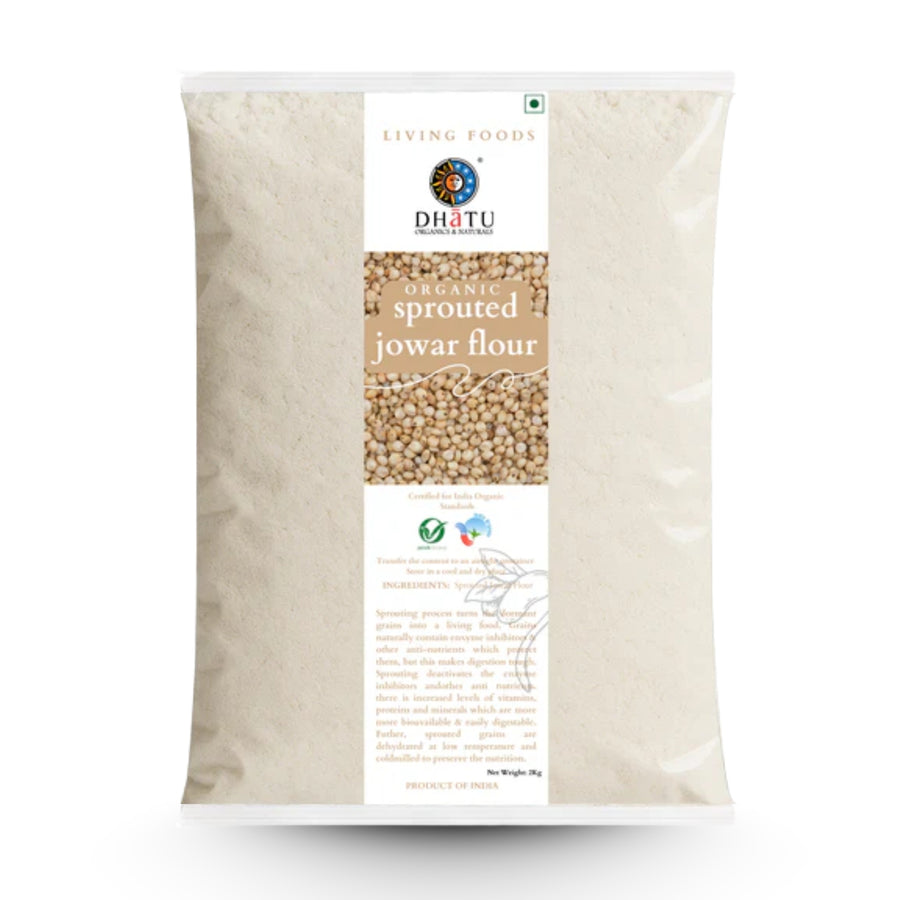
Organic Sprouted Jowar Flour 500g | Cold Milled
₹ 160.00
India's most widely eaten millet — sprouted to unlock its protein and cold milled to preserve every B vitamin. Jowar has been a staple of the Deccan plateau for 3000 years, an... Read more ↓
100% Organic
No Additives
Free Delivery ₹499+
100% Organic Sprouted Jowar (Sorghum / Sorghum bicolor)
Nutrition FactsServing: 30g
| Nutrient | Per serving | Per 100g | % RDA* |
|---|---|---|---|
| Energy | 102 kcal | 339 kcal | 5.1% |
| Protein | 3.3 g | 11 g | 6.6% |
| Carbohydrates | 21.6 g | 72 g | 7.2% |
| of which Sugars | 0.9 g | 3 g | 1.8% |
| Dietary Fibre | 2.1 g | 7 g | 8.4% |
| Fat | 0.99 g | 3.3 g | 1.5% |
| of which Saturated Fat | 0.15 g | 0.5 g | <1% |
| Iron | 1.3 mg | 4.4 mg | 7.8% |
| Calcium | 8.4 mg | 28 mg | <1% |
| Potassium | 105 mg | 350 mg | 2.6% |
| Magnesium | 49.5 mg | 165 mg | 12.4% |
| Phosphorus | 86.1 mg | 287 mg | 8.6% |
| Zinc | 0.51 mg | 1.7 mg | 4.3% |
| Vitamin B3 (Niacin) | 1.1 mg | 3.7 mg | 6.9% |
* % RDA based on a 2000 kcal reference diet (FSSAI). Values are approximate and may vary by batch.
We deliver across India within 3–5 business days via trusted logistics partners.
- Free delivery on orders above ₹499.
- Orders dispatched within 1 business day of payment confirmation.
- Perishable goods cannot be returned once dispatched. Non-perishable items may be returned within 7 days in original, unopened condition.
- For damaged or incorrect items, contact info@dhatuorganics.com within 48 hours of delivery.
Choose Your Pack
India's most widely eaten millet — sprouted to unlock its protein and cold milled to preserve every B vitamin. Jowar has been a staple of the Deccan plateau for 3000 years, and this is its most nutritious form.
Why Sprouted and Cold Milled?
Jowar (sorghum) contains a protein called kafirin which, in its natural state, is resistant to digestion — only 46% of its protein is usable by the body when eaten unsprouted. Sprouting breaks down kafirin structures and activates enzymes that improve protein digestibility by up to 35%, making the nutritional value of the grain far more realisable. Cold milling then ensures the heat-sensitive B vitamins, antioxidants, and natural oils are preserved — conventional stone-milling and roller milling generate heat that damages these nutrients.
Key Benefits
- Gluten-free — a safe wheat substitute for coeliac and gluten-sensitive individuals
- 24% daily iron per 100g — meaningful contribution to daily iron needs
- 165mg magnesium — supports sleep quality, muscle function, and heart rhythm
- High niacin (B3) — 3.7mg per 100g, supports energy metabolism and skin health
- Improved protein digestibility — sprouting increases usable protein by up to 35%
- 7g dietary fibre — feeds gut microbiome and supports digestive regularity
- Traditional digestive grain — lighter on the stomach than wheat for many people
How to Use
- Jowar roti / bhakri — knead with hot water, roll thin, cook dry on tawa
- Use in gluten-free dosas and pancakes
- Mix with other flours for gluten-free baking (bread, muffins, cookies)
- Make jowar porridge — similar to polenta or upma
- Use as a coating for fried or baked snacks
- Blend into smoothies or health drinks for added fibre
Frequently Asked Questions
What does cold milling mean?
Cold milling means the flour is ground at a controlled low temperature, unlike conventional mills where friction generates heat up to 80–100°C. High heat destroys heat-sensitive nutrients including B vitamins, antioxidants, and natural oils. Cold milling preserves these intact, resulting in a nutritionally superior flour.
Can jowar roti be made as soft as wheat roti?
Jowar roti (bhakri) is traditionally thicker and firmer than wheat roti — it has a different texture profile. To make it softer, knead with boiling water and keep covered with a damp cloth while rolling. Adding a small amount of our sprouted wheat flour (5–10%) can help with binding if desired.
Is jowar suitable for diabetics?
Yes — jowar has a moderate glycaemic index (around 62) that is improved further in sprouted form. Its high fibre content slows starch digestion. Jowar rotis are a traditional part of diabetic diets across Maharashtra and Karnataka.
How is jowar different from bajra?
Both are millets, but from different plants. Jowar (sorghum) has a milder, more neutral flavour and is typically easier to digest. Bajra (pearl millet) has a stronger earthy flavour and is higher in fat and iron. Both are gluten-free and nutritionally excellent.