

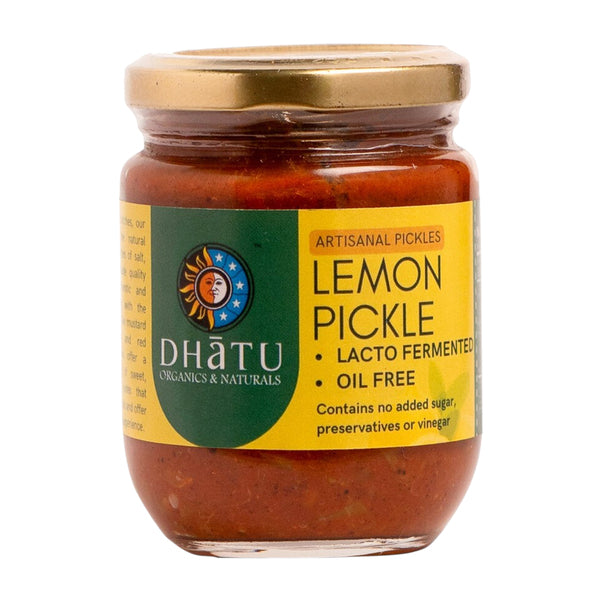
Lacto-Fermented Lemon Pickle 250g – No Oil, No Vinegar
₹ 250.00
Dhatu Organics Lacto-Fermented Lemon Pickle uses whole lemons — peel, pith, flesh, and seeds — salt-brined and naturally fermented without oil, without vinegar, and without p... Read more ↓
100% Organic
No Additives
Free Delivery ₹499+
Whole Lemons (Citrus limon) — peel, pith, flesh & seeds, Sea Salt, Organic Turmeric Powder, Red Chilli, Cumin Seeds (Cuminum cyminum), Fenugreek Seeds (Trigonella foenum-graecum)
Nutrition Facts
| Nutrient | Per serving | Per 100g | % RDA* |
|---|---|---|---|
| Energy | 10 kcal | 50 kcal/100g | |
| Protein | 0.20 g | 1.0 g/100g | |
| Carbohydrates | 2.8 g | 14.0 g/100g | |
| — of which Sugars | 0.4 g | 2.0 g/100g | |
| Total Fat | 0.06 g | 0.3 g/100g | |
| Dietary Fibre | 0.9 g | 4.5 g/100g | |
| Sodium | 500 mg | 2500 mg/100g | |
| Vitamin C | 14 mg | 70 mg/100g |
* % RDA based on a 2000 kcal reference diet (FSSAI). Values are approximate and may vary by batch.
We deliver across India within 3–5 business days via trusted logistics partners.
- Free delivery on orders above ₹499.
- Orders dispatched within 1 business day of payment confirmation.
- Perishable goods cannot be returned once dispatched. Non-perishable items may be returned within 7 days in original, unopened condition.
- For damaged or incorrect items, contact info@dhatuorganics.com within 48 hours of delivery.
Choose Your Pack
Dhatu Organics Lacto-Fermented Lemon Pickle uses whole lemons — peel, pith, flesh, and seeds — salt-brined and naturally fermented without oil, without vinegar, and without preservatives. The entire lemon undergoes lacto-fermentation, which softens the rind, matures the flavour over weeks, and develops a complex, deeply sour, slightly bitter preserve that is one of the most revered condiments in Indian cooking. Whole-lemon pickling extracts phytochemicals from the peel that would otherwise be discarded — including limonene, hesperidin, and eriocitrin — delivering them in a live-culture, probiotic-rich brine.
The Whole-Lemon Advantage: Most lemon-based products use only the juice. Dhatu's whole-lemon lacto-fermentation uses the entire fruit — rind and all. The lemon peel is the richest source of limonene (a monoterpene with documented liver-supportive, anti-inflammatory, and cholesterol-modulating properties), hesperidin (endothelial function), and eriocitrin. The fermentation process breaks down the peel's bitter compounds into more palatable, bioavailable forms over time — a process similar to what happens in traditional Moroccan preserved lemons, but without oil.
🌿 Ingredients
- Whole Lemons (Citrus limon) — peel, pith, flesh, seeds
- Sea Salt (non-iodised)
- Organic Turmeric Powder (Curcuma longa)
- Red Chilli (Capsicum annuum)
- Cumin Seeds (Cuminum cyminum)
- Fenugreek Seeds (Trigonella foenum-graecum)
No oil · No vinegar · No preservatives · No artificial colour
Lacto-Fermented
Oil-Free
Probiotic-Rich
Vegan
📊 Nutrition Facts
Per 100g · Per 20g serving (1 heaped tbsp)
| Nutrient | Per 100g | Per 20g |
|---|---|---|
| Energy | 50 kcal | 10 kcal |
| Protein | 1.0 g | 0.20 g |
| Carbohydrates | 14.0 g | 2.8 g |
| — of which Sugars | 2.0 g | 0.4 g |
| Total Fat | 0.3 g | 0.06 g |
| Dietary Fibre | 4.5 g | 0.9 g |
| Sodium | 2,500 mg | 500 mg |
| Vitamin C | 70 mg | 14 mg |
| Hesperidin | ~500 mg/100g (from peel) | |
| Live Cultures | 10⁷–10⁹ CFU/g (L. plantarum, L. fermentum) | |
Values approximate. Hesperidin primarily from lemon peel — whole-lemon pickling delivers significantly more than juice-only preparations. Probiotic counts at time of packing.
The Phytochemical Profile of Whole Lemon
HesperidinPeel flavanone — endothelial function, blood pressure support
LimonenePeel monoterpene — liver detoxification, cholesterol modulation
EriocitrinPeel flavanone — antioxidant, anti-inflammatory
Vitamin C70mg/100g — immune, collagen, iron absorption
Lactic AcidFermentation product — gut acidifier, probiotic byproduct
Cumin (Cuminaldehyde)Carminative, digestive antispasmodic
Key Benefits
- Hesperidin for Cardiovascular Health: Hesperidin — concentrated in the lemon peel — is a flavanone glycoside with human clinical evidence for improving endothelial function, reducing LDL oxidation, and modestly lowering blood pressure. An RCT found hesperidin supplementation improved endothelium-dependent vasodilation in metabolic syndrome patients. Whole-lemon pickling delivers bioavailable hesperidin in food form.
- Limonene — The Underappreciated Peel Compound: D-limonene is a monoterpene found almost exclusively in citrus peel. It has been shown to induce Phase I and II detoxification enzymes in the liver, modulate cholesterol biosynthesis, and demonstrate anti-proliferative effects in cell culture studies. This pickle delivers it in every tablespoon.
- Probiotic Cultures from Lacto-Fermentation: The lemon's natural sugars and salt brine create ideal conditions for Lactobacillus plantarum and L. fermentum to colonise. The resulting live cultures contribute to gut microbiome maintenance and immune modulation — delivered in a food matrix with co-occurring polyphenols and fibres.
- Digestive Bitterness Principle: The bitter compounds in lemon peel (limonin and related limonoids) stimulate bile secretion and liver function. In Ayurveda, bitter and sour tastes are considered the most effective for stimulating digestive fire. A small amount of this pickle before meals is a classical digestive primer consistent with both traditional medicine and contemporary evidence.
- Highest Vitamin C in the Pickle Range: At 70mg Vitamin C per 100g (14mg per tablespoon), this pickle provides the highest Vitamin C concentration of the four pickles — supporting immune function, collagen synthesis, and enhancing iron absorption from plant-based meals.
- Fenugreek + Cumin — Carminative Pair: Fenugreek and cumin are among the most widely used carminative spices in traditional medicine across multiple cultures. Together they reduce intestinal gas, soothe bloating, and support gastric motility — making this pickle particularly useful for people who experience post-meal digestive discomfort.
Research Summary
| Compound | Source | Evidence Level | Observed Effect |
|---|---|---|---|
| Hesperidin | Lemon peel | RCT (human) | Endothelial function ↑, blood pressure ↓ |
| D-Limonene | Lemon peel | Clinical + preclinical | Phase II enzymes ↑, cholesterol ↓ |
| L. plantarum (live cultures) | Lacto-fermentation | Multiple RCTs | Microbiome diversity ↑, gut barrier ↑ |
| Limonoids (Limonin) | Lemon peel | Mechanistic + traditional | Bile secretion ↑, liver detox support |
| Cuminaldehyde | Cumin seeds | In vitro + traditional | Carminative, antispasmodic, antimicrobial |
| Vitamin C | Whole lemon | Extensive RCT evidence | Immune function ↑, collagen ↑, Fe absorption ↑ |
Serving Suggestions
- The South Indian Way: A teaspoon of lemon pickle alongside curd rice is one of the most iconic South Indian meal combinations — the tartness of the pickle cuts through the cooling curd perfectly.
- Before Heavy Meals: Eat ½–1 tsp before a rich, oily, or heavy meal to prime bile secretion and digestive enzyme activity.
- With Thali and Dal: A standard component of any proper South Indian or Gujarati thali. Serves both flavour and digestive function.
- In Marinades: Mash ½–1 tsp into a marinade for fish, prawns, or paneer. The organic acids tenderise protein while the spices add depth.
- With Plain Yoghurt: Stir 1 tsp into plain yoghurt for a quick, probiotic-stacked raita.
- As a Palate Cleanser: Small amounts between courses or at the end of a meal to cleanse the palate and support digestion.
Frequently Asked Questions
Does it use the entire lemon including the peel?
Yes. Whole lemons — including the peel, pith, and seeds — are used in this pickle. This is what makes it nutritionally superior to juice-only preparations. The peel contains hesperidin, limonene, and eriocitrin at concentrations many times higher than the juice. The fermentation process transforms the bitter compounds in the peel into more palatable, bioavailable forms over time.
How sour is it?
Very sour — this is a traditional lemon pickle and is intensely tart. The sourness comes from both the natural citric acid in the lemon and the lactic acid produced during fermentation. The salt, red chilli, and spices balance this, but it is not a mild pickle. Most people use small amounts (½–1 tsp) per serving, which is how it's traditionally enjoyed.
What is the difference between this and the Ginger Lemon Pickle?
The Ginger Lemon Pickle uses fresh ginger as the primary ingredient with lemon as an acidifier — the flavour profile is dominated by spicy ginger with bright lemon notes. The Lemon Pickle uses whole lemons as the primary ingredient, making lemon the star — deeper, more bitter-sour, and more complex. Both are lacto-fermented and oil-free, but they offer very different flavour experiences.
Is it safe for people with acid reflux?
High-acid foods can trigger reflux in susceptible individuals. If you have GERD or chronic acid reflux, it is advisable to consume it only with food (never on an empty stomach) and in small quantities. The digestive enzymes and probiotics in the brine are beneficial for gut health, but the citric and lactic acid content may aggravate reflux in sensitive individuals. Consult your physician if unsure.
Are the seeds in the pickle edible?
Lemon seeds are included in whole-lemon pickling as they soften during fermentation. They are edible and contain limonoids in concentrated form. They are not bitter after fermentation. Most people eat the entire piece — peel, flesh, and seeds — as a pickle portion.
Explore More from Dhatu Organics
- Ginger Lemon Pickle — ginger-led, less bitter, equally probiotic
- Mixed Vegetable Pickle — lighter, crunchy, multi-vegetable probiotic medley
- Mango Pickle — fruity tartness, mangiferin-rich
- Amla Powder — another whole-fruit Vitamin C powerhouse
- All Health Supplements
Scientific References
- Rizza S, et al. Citrus polyphenol hesperidin stimulates production of nitric oxide in endothelial cells while reducing inflammatory markers. J Nutr. 2011;141(10):1764–8. doi:10.3945/jn.111.141804
- Crowell PL. Prevention and therapy of cancer by dietary monoterpenes. J Nutr. 1999;129(3):775S–778S. doi:10.1093/jn/129.3.775S
- Wastyk HC, et al. Gut-microbiota-targeted diets modulate human immune status. Cell. 2021;184(16):4137–4153. doi:10.1016/j.cell.2021.06.019
- Johri RK. Cuminum cyminum and Carum carvi: an update. Pharmacogn Rev. 2011;5(9):63–72. doi:10.4103/0973-7847.79101